
False chanterelle
Hygrophoropsis aurantiaca · False chanterelles (Hygrophoropsidaceae)
Inedible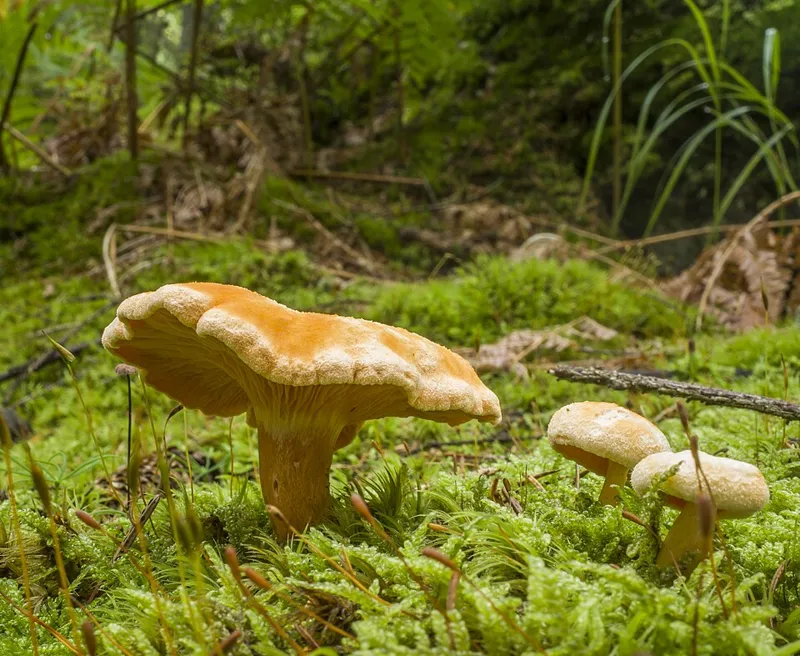
Recognise it safely – what matters
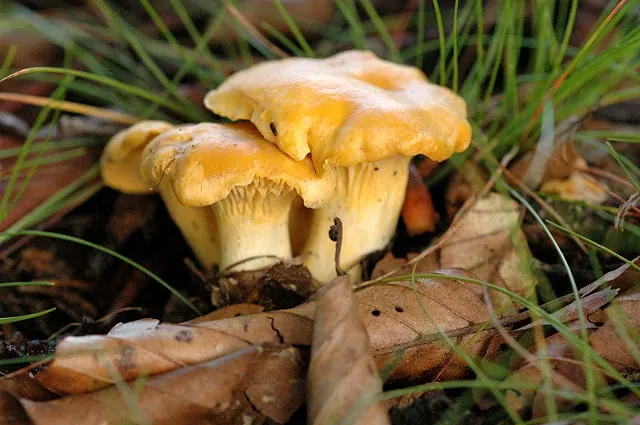
- Thin, crowded, forked gills (chanterelle: thick, low ridges running down the stem)
- Flesh soft and orange (chanterelle: firm, fibrous, whitish inside)
- Grows on needle litter and wood
Features
- Cap
- 2–8 cm, orange to orange-brown, finely felty, soon funnel-shaped with an inrolled margin.
- Underside
- True, thin gills, crowded and repeatedly forked, bright orange.
- Stem
- Thin, same colour as the cap or darker.
- Flesh
- Soft, flexible, tinged orange.
- Smell
- Indistinct
- Spore print
- White to cream
Season
JFMAMJJASOND
Habitat
Coniferous forests, on needle litter and rotting wood, often in groups.
Spruce, Pine
Risk of confusion
If someone has eaten it
Nausea or diarrhoea in sensitive people.
Act immediately – even without symptoms:
- Emergency number 112 if someone feels unwell.
- Poison centre: Germany – area code of the nearest city with a poison centre + 19240 (e.g. Berlin 030 19240, Munich 089 19240) · Austria +43 1 406 43 43 · Switzerland 145.
- Keep leftovers, trimmings or vomit – it helps with identification.
Never identify mushrooms by pictures or an app alone. When in doubt, ask a mushroom expert – and only pick what you know for sure.