
Destroying angel
Amanita virosa · Amanitas (Amanita)
Deadly poisonous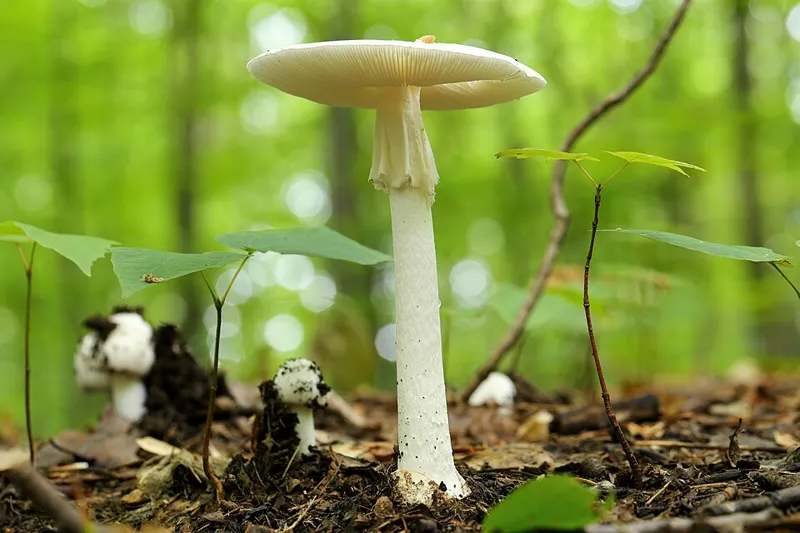
Deadly poisonous – the same toxin as the death cap. A single mushroom can kill. Cooking, drying or freezing do not destroy it.
Recognise it safely – what matters
- Entirely white – including the gills, for life
- Ring (often only remnants) and bulb with a sac
- Always dig up the whole mushroom: the bulb is often in the soil
Features
- Cap
- 4–10 cm, pure white, conical to bell-shaped when young, later flattened with a boss.
- Underside
- Gills: white, free, crowded – stay white.
- Stem
- White, flaky-fibrous; hanging, often torn ring; at the base a bulb with a membranous sac.
- Flesh
- White, does not discolour.
- Smell
- Unpleasantly sweetish to radish-like.
- Spore print
- White
Season
JFMAMJJASOND
Habitat
Coniferous and mixed forests on acidic soils, often near spruce, also under beech and birch; more common in hilly and mountain areas.
Épicéa, Hêtre, Bouleau
Risk of confusion
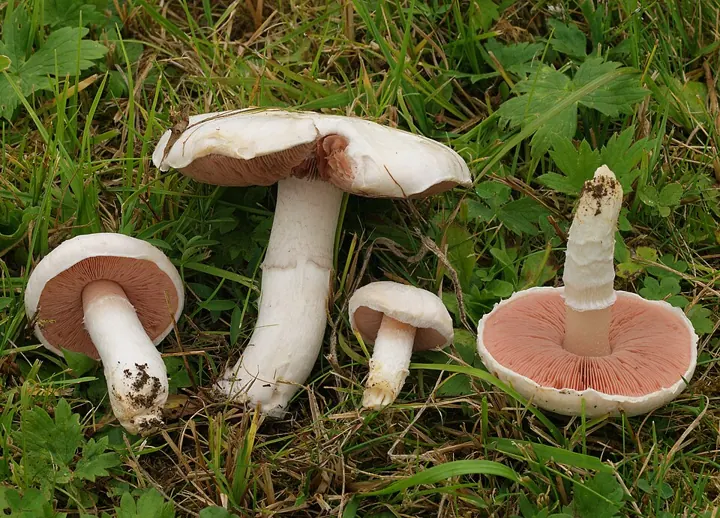 Rosé des prés Edible species Field mushrooms have pink, later chocolate-brown gills and no bulb with a sac. Never pick very young, still closed mushrooms!
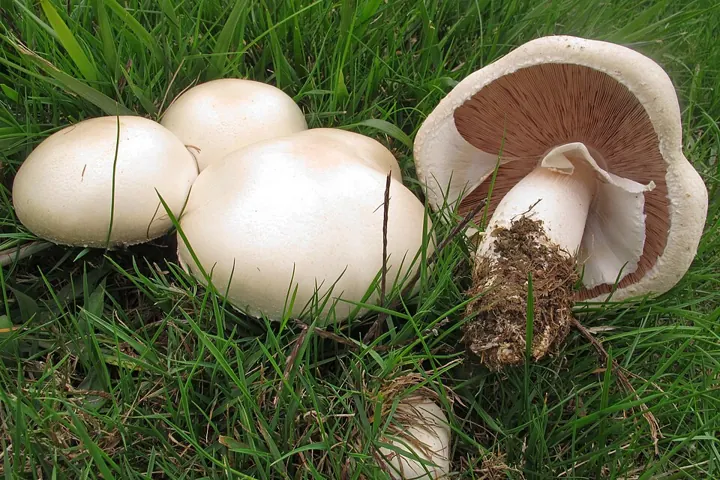 Agaric des champs Edible species The horse mushroom smells clearly of aniseed, yellows and has greyish-pink to brown gills.
If someone has eaten it
Nothing at first. Then violent vomiting and diarrhoea, often followed by a deceptive improvement – while the liver is being severely damaged. Without early treatment, liver failure can follow. First symptoms: usually 6–24 hours after eating.
Act immediately – even without symptoms:
- Emergency number 112 if someone feels unwell.
- Poison centre: Germany – area code of the nearest city with a poison centre + 19240 (e.g. Berlin 030 19240, Munich 089 19240) · Austria +43 1 406 43 43 · Switzerland 145.
- Keep leftovers, trimmings or vomit – it helps with identification.
Never identify mushrooms by pictures or an app alone. When in doubt, ask a mushroom expert – and only pick what you know for sure.