
Satan's bolete
Rubroboletus satanas · Boletes (Boletaceae)
Poisonous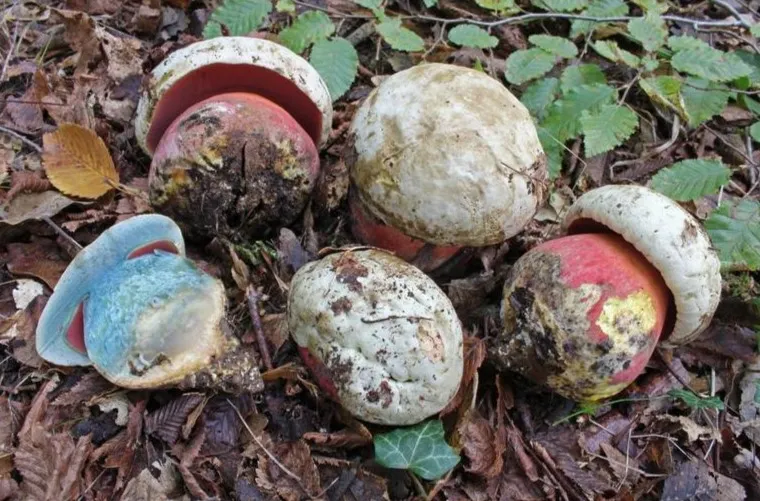
Poisonous. Causes violent gastrointestinal poisoning, raw or cooked.
Recognise it safely – what matters
- Pale, chalky grey cap – from above like a porcini
- Red pores and red, netted stem
- Chalky soil, warm broadleaf forests
Features
- Cap
- 8–25 cm, whitish to olive grey, as if dusted with chalk.
- Underside
- Pores: blood red to orange-red.
- Stem
- Thick, bulbous; yellow at the top, red further down with a red network.
- Flesh
- Yellowish, only weakly blues when cut.
- Smell
- Unpleasant, carrion-like when older.
- Spore print
- Olive brown
Season
JFMAMJJASOND
Habitat
Warm broadleaf forests on chalky soil, under beech and oak. Rare and protected in many regions.
Bøg, Eg
Risk of confusion
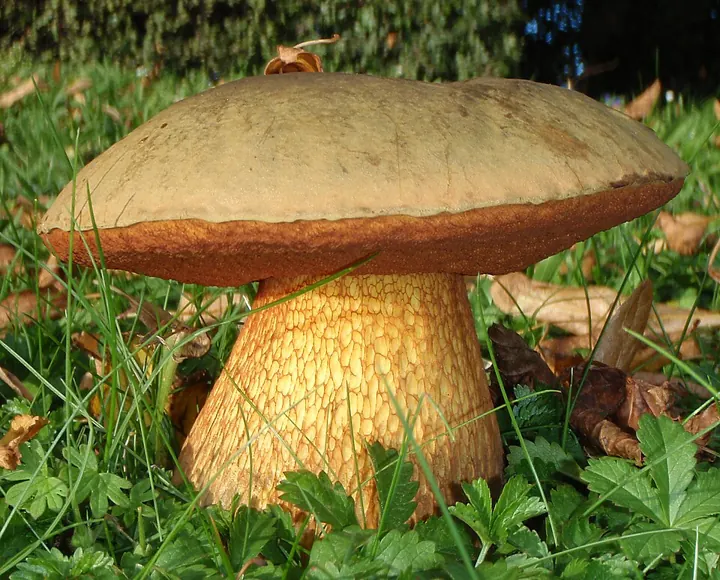 Netstokket indigo-rørhat Edible species The lurid bolete also has red pores, but an olive to leather-brown cap, and it blues strongly as soon as it is cut.
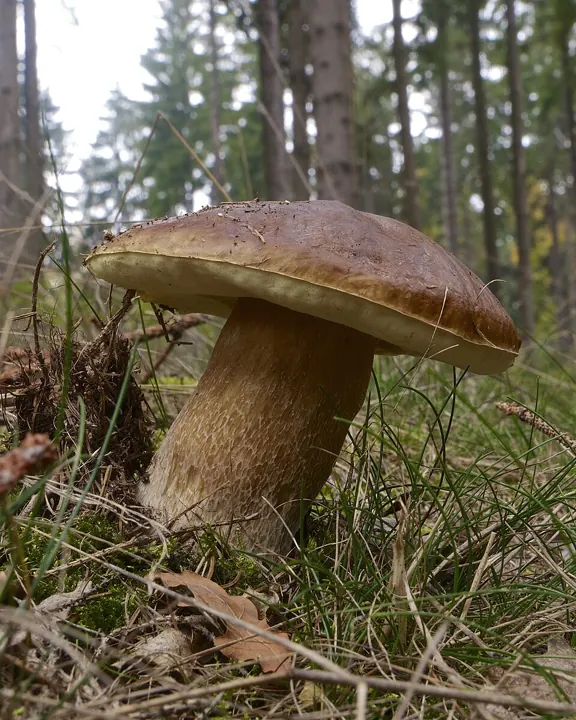 Spiselig rørhat Edible species Only similar from above: porcini have white to olive-yellow tubes, never red ones.
If someone has eaten it
Violent vomiting, diarrhoea and stomach cramps; in children and older people the loss of fluids can become dangerous. First symptoms: usually 1–4 hours after eating.
Act immediately – even without symptoms:
- Emergency number 112 if someone feels unwell.
- Poison centre: Germany – area code of the nearest city with a poison centre + 19240 (e.g. Berlin 030 19240, Munich 089 19240) · Austria +43 1 406 43 43 · Switzerland 145.
- Keep leftovers, trimmings or vomit – it helps with identification.
Never identify mushrooms by pictures or an app alone. When in doubt, ask a mushroom expert – and only pick what you know for sure.