
Panther cap
Amanita pantherina · Amanitas (Amanita)
Poisonous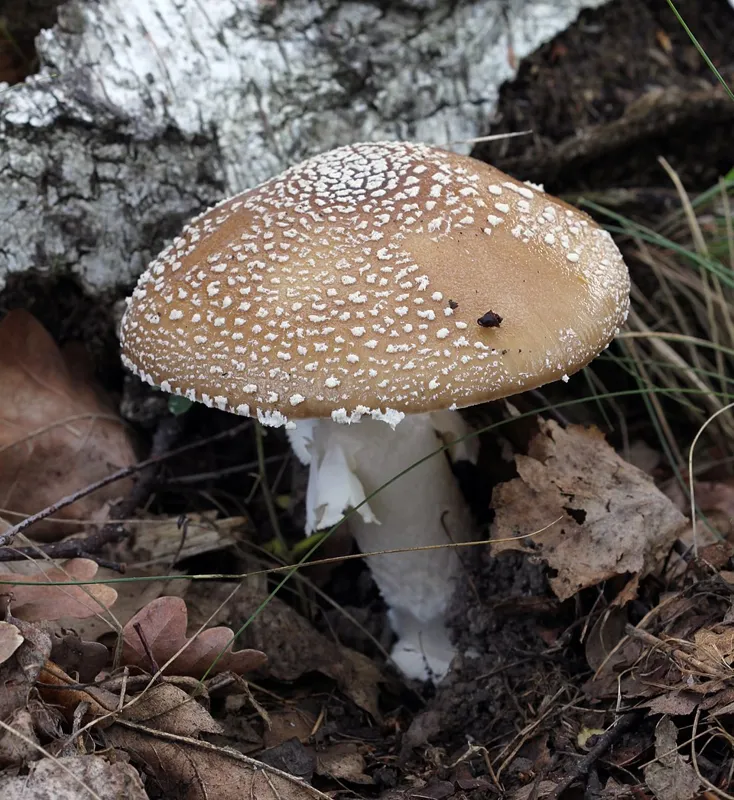
Poisonous, considerably stronger than the fly agaric. Severe poisonings are possible. Mainly confused with the blusher and the grey spotted amanita.
Recognise it safely – what matters
- Brown cap with pure white flakes and striate margin
- Smooth ring, bulb with a rolled rim
- Flesh never reddens – the edible blusher reddens where damaged and on the stem
Features
- Cap
- 5–12 cm, light to dark brown with pure white flakes; margin clearly striate.
- Underside
- Gills: white, free.
- Stem
- White; ring smooth, not striate; bulb with a distinct, rolled rim ("climber's sock").
- Flesh
- White, does not discolour – not even where eaten by animals.
- Smell
- Indistinct, somewhat radish-like.
- Spore print
- White
Season
JFMAMJJASOND
Habitat
Broadleaf and coniferous forests, often under beech, oak and pine, frequently on sandy soils.
Beuk, Eik, Den, Fijnspar
If someone has eaten it
Confusion, agitation, visual disturbances, dizziness, vomiting, seizures; often followed by deep sleep. First symptoms: usually after 30 minutes to 3 hours.
Act immediately – even without symptoms:
- Emergency number 112 if someone feels unwell.
- Poison centre: Germany – area code of the nearest city with a poison centre + 19240 (e.g. Berlin 030 19240, Munich 089 19240) · Austria +43 1 406 43 43 · Switzerland 145.
- Keep leftovers, trimmings or vomit – it helps with identification.
Never identify mushrooms by pictures or an app alone. When in doubt, ask a mushroom expert – and only pick what you know for sure.