
🍄 Spring in the forest
Morels: when and where they grow
Morels are among the first mushrooms of spring. Here you can see when morel season usually starts near you, where to look – and how to safely recognise the poisonous false morel.
Morel season near you
First finds usually from the week of 22 March – most until about 26 April.
For Welling (about 169 m above sea level). This is the usual week. Morels depend strongly on the spring – in warm years the season starts up to two weeks earlier, in cold years later. From mid-February we show here whether spring is early this year.
Rule of thumb: when blackthorn is in white flower, morel season begins.
Where to find morels
Floodplains and streams
Under ash, elm and poplar, in floodplain forests and along streams – often where wild garlic grows in spring too.
Edges and orchards
At forest edges, hedges and in old orchards, usually on loose, lime-rich soil.
Black morels
Black morels also appear on bark mulch in gardens and parks and on old fire sites.
🛡 Protected – small amounts only Morel profile →
⚠️ Morel or false morel?
Deadly poisonous. The toxin is also released when cooking – even the fumes can be harmful. Once traded as edible; that is outdated.
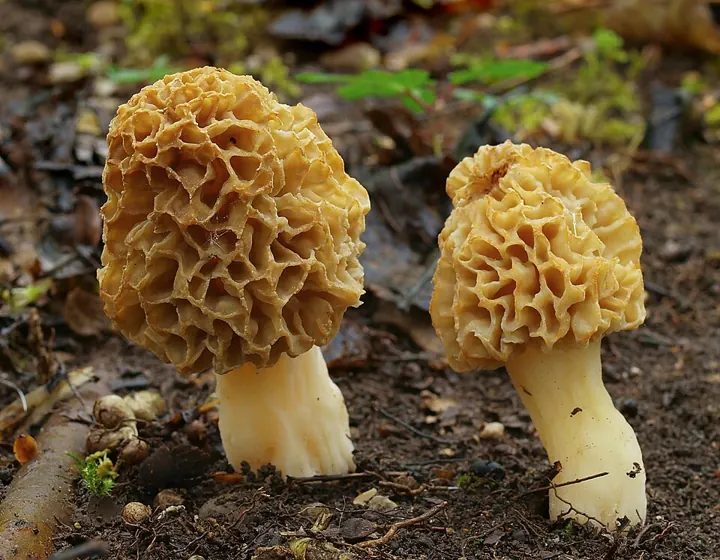
Morel
- Cap honeycomb-like with pits and ridges
- Cut lengthwise: one single continuous hollow
- Broadleaf and floodplain forest, orchards; black morel also on bark mulch
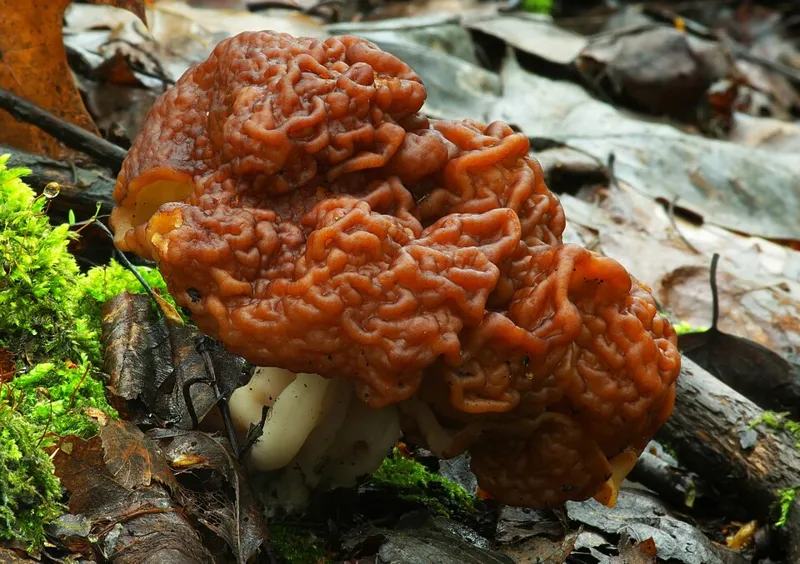
How to check: Morels have a honeycomb cap with pits and are one single hollow inside – false morels are convoluted and chambered. When in doubt, cut lengthwise.
More spring lookalikes
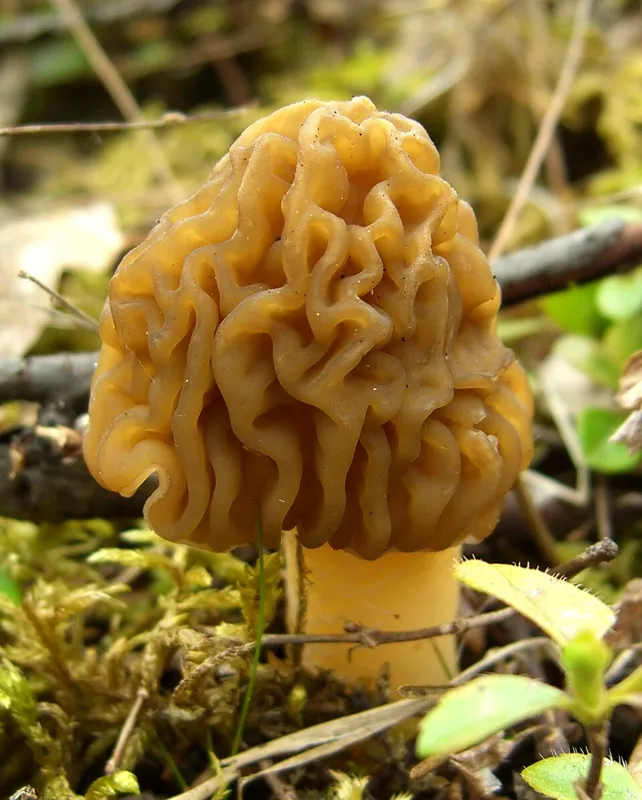
- Cap attached only at the tip, hangs free like a thimble
- Cap folded lengthwise, no true honeycomb
- Cut lengthwise: stem filled with cottony pith (morel: cap and stem one single hollow)
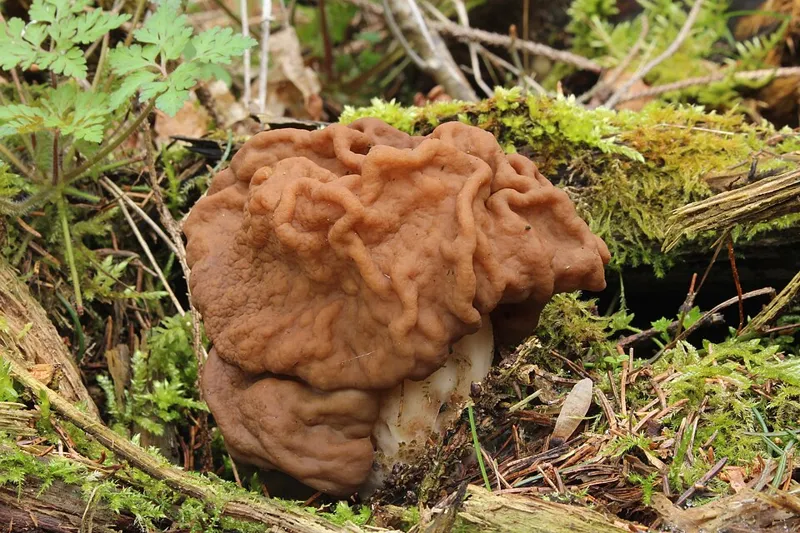
- Large, brain-like, ochre yellow – no honeycomb
- Stem short, very thick, white; chambered when cut lengthwise
- Mountain forest in late spring, near rotting conifer wood
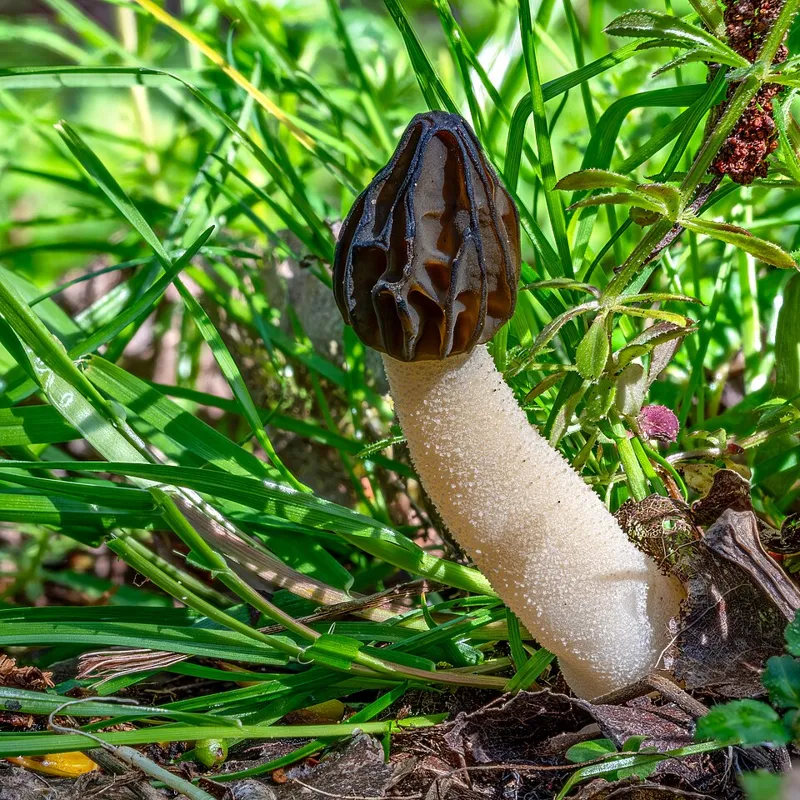
- Cap attached to about halfway, free below like a skirt
- Pits between lengthwise ridges, no folds
- Cut lengthwise: cap and stem one single hollow, no pith
⚠️ Even true morels are poisonous raw. Never taste them raw – not even “just a little bit” to identify them.
If in doubt, leave it. Have uncertain finds checked by a mushroom advisor.
If someone has eaten a false morel
Vomiting, diarrhoea, headache, weakness; later damage to the liver, kidneys and nervous system. First symptoms: usually 6–12 hours after eating.
📞 Act immediately – even without symptoms:
- Emergency number 112 if someone feels unwell.
- Poison centre: Germany – area code of the nearest city with a poison centre + 19240 (e.g. Berlin 030 19240, Munich 089 19240) · Austria +43 1 406 43 43 · Switzerland 145.
- Keep leftovers, trimmings or vomit – it helps with identification.
What the rules say
- All native morels are specially protected. A small amount for personal use is allowed.
- In nature reserves picking is usually prohibited – watch for the signs.
- Leave small morels standing and do not disturb the ground around the spot.
Mushrooms in winter and spring → · Mushroom alert for spring →
Frequently asked questions
When is morel season?
In Germany usually from late March to mid-May, later in the uplands. The first morels appear roughly when blackthorn flowers; most finds fall in the three to five weeks after. For your place, the box above shows the usual week.
Where do morels grow?
In floodplain forests and along streams, under ash, elm and poplar, at forest edges and in old orchards – usually on loose, lime-rich soil. Black morels also turn up on bark mulch and old fire sites.
How do I tell a morel from a false morel?
Morels have a honeycomb cap with pits and are one single hollow inside – false morels are convoluted and chambered. When in doubt, cut lengthwise.
What other lookalikes do morels have?
The early false morel (suspected poisonous): its cap hangs free like a thimble, attached only at the tip, and the stem is filled with pith. The snow false morel (poisonous): large, brain-like, in mountain forest near rotting conifer wood. The half-free morel is a true morel but looks very similar to the early false morel. Even true morels are poisonous raw.
What if someone has eaten a false morel?
Call a poison centre at once, even without symptoms (Germany: area code of the nearest city with a poison centre + 19240, Austria +43 1 406 43 43, Switzerland 145), and 112 if someone feels unwell. Vomiting, diarrhoea, headache, weakness; later damage to the liver, kidneys and nervous system. First symptoms: usually 6–12 hours after eating.
Is picking morels allowed?
All native morels are specially protected under the German Federal Species Protection Ordinance. A small amount for personal use is allowed; in nature reserves picking is usually prohibited.